
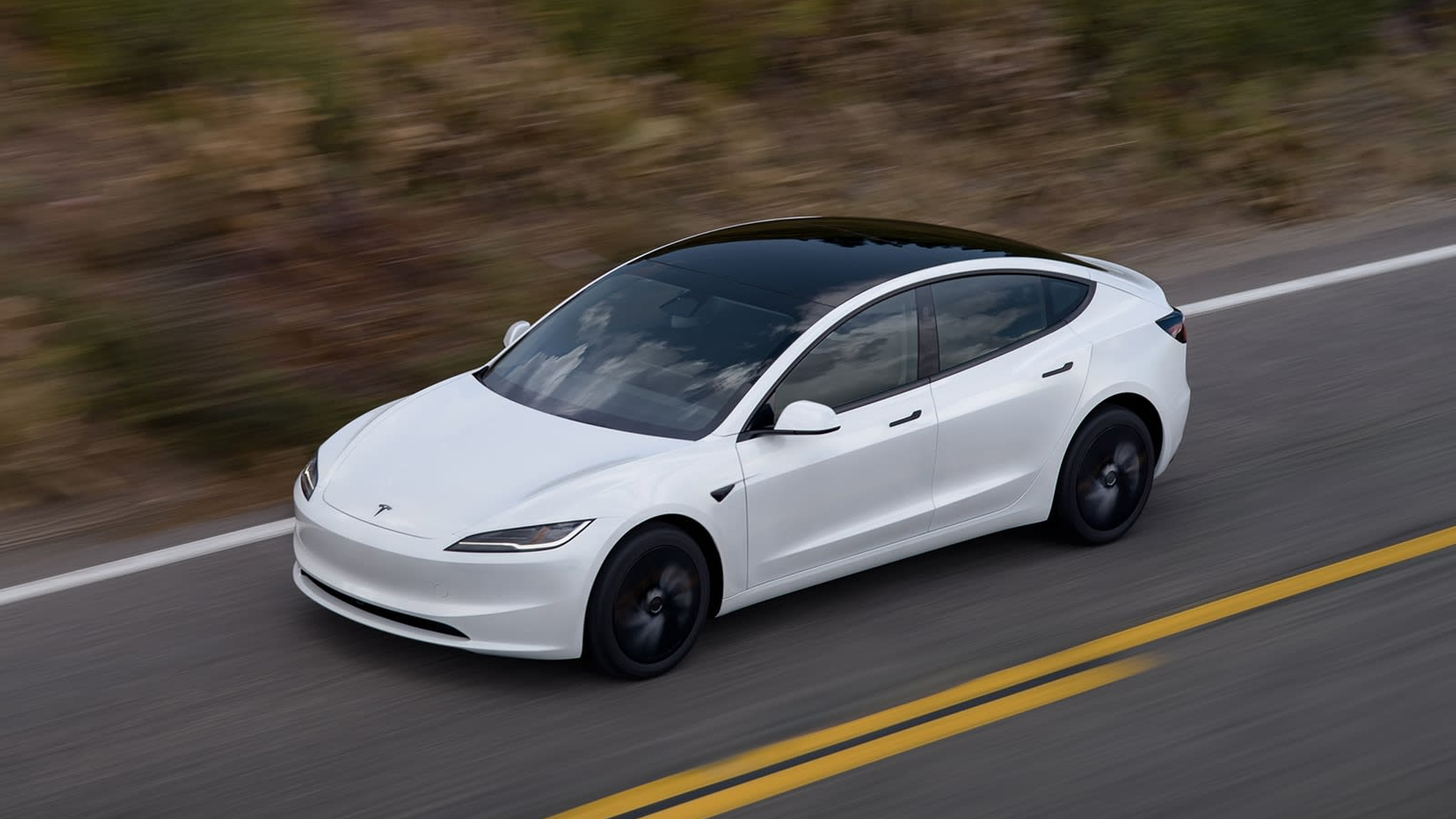
Scaling the Electric Dream
The Tesla Model 3 executed the most aggressive manufacturing scale-up in modern automotive history. Legacy automakers assumed building a high-volume, affordable BEV was financially impossible. Tesla destroyed that assumption. Built on a dedicated skateboard chassis, the Model 3 packages its heavy energy storage securely beneath the floor pan. This architectural decision fundamentally changed passenger sedan dynamics, dropping the center of gravity to exotic sports car levels while opening up massive interior volume previously occupied by exhaust routing and transmission tunnels.
In 2021, the Tesla Model 3 became the first electric vehicle in global history to surpass one million cumulative sales, permanently altering the trajectory of the automotive supply chain and forcing a worldwide pivot toward electrification.
Architectural Integrity and Suspension Geometry
Engineers rejected the compromised, shared internal-combustion platforms utilized by early competitors. The Model 3 utilizes a proprietary aluminum and high-strength steel unibody. This hybrid metal construction maximizes impact absorption zones while minimizing overall curb weight. The battery pack acts as a stressed structural member, vastly increasing the torsional rigidity of the frame. This sheer stiffness allows the suspension to process road imperfections without transferring violent shock energy through the passenger cabin.
Up front, the vehicle employs a short/long arm (SLA) double-wishbone suspension featuring a virtual steer axis. This advanced geometry provides exceptional camber control during aggressive cornering. The rear utilizes a complex multi-link setup. These mechanical foundations grant the heavy sedan the agility of a lightweight track weapon. The steering rack features an ultra-quick 10.3:1 ratio, delivering razor-sharp turn-in response that completely masks the vehicle's actual mass.
Powertrain Topologies: RWD to Performance AWD
Propulsion configurations evolved dramatically since the 2017 launch. Base models utilize a single, rear-mounted Permanent Magnet Switched Reluctance Motor (PMSRM). This specific motor design reduces reliance on heavy rare-earth metals while maintaining exceptional thermal efficiency at high cruising speeds. Pushing the accelerator delivers instant, linear torque, breaking traction seamlessly before the traction control ECU intercepts the slip.
Dual Motor variants add an alternating current (AC) induction motor to the front axle. Because no physical driveshaft links the front and rear wheels, the onboard computers can digitally vector torque in a matter of milliseconds. If the right rear tire encounters a patch of black ice, the system instantly cuts power to that wheel and forces maximum amperage to the front axle to maintain forward momentum.
Model 3 Performance Core Specifications
- Powertrain Architecture
- Dual Motor All-Wheel Drive
- Peak Horsepower
- Up to 510 hp (Highland Performance)
- Acceleration (0-60 mph)
- 2.9 seconds
- Top Speed
- 163 mph
- Suspension
- Adaptive Damping (Performance Trim Only)
Battery Chemistry and the Octovalve Thermal System
Energy storage dictates both range and longevity. Tesla utilizes two distinct battery chemistries within the Model 3 lineup to optimize production costs and vehicle lifespan. Standard Range vehicles employ Lithium Iron Phosphate (LiFePO4) cells. This highly stable chemistry tolerates charging to 100 percent daily without suffering severe cell degradation. Long Range and Performance models utilize a Nickel-Cobalt-Aluminum (NCA) or Nickel-Manganese-Cobalt (NMC) blend, achieving significantly higher energy density to cross the 340-mile range threshold.
Managing the extreme heat generated during a 250-kilowatt Supercharging session requires brilliant thermal engineering. Tesla discarded traditional, independent cooling loops for the battery, motors, and cabin. They integrated these systems using the patented Octovalve. This complex manifold acts as the central nervous system for vehicle thermals. It scavenges waste heat generated by the spinning electric motors and redirects it to warm the lithium-ion battery pack on cold winter mornings. A warm battery accepts charge faster and discharges energy more efficiently. Conversely, the system utilizes a highly efficient heat pump to condition the passenger cabin, draining significantly less high-voltage energy than primitive resistive heating coils.
The transition from resistive heating to the Octovalve heat pump system increased the cold-weather driving range of the Model 3 by up to 15 percent, solving one of the most critical engineering challenges facing electric vehicles in northern climates.
Aerodynamic Dominance and Project Highland
Atmospheric resistance brutally punishes electric driving range at highway speeds. The Model 3 was shaped entirely by the wind tunnel. The lack of a massive internal combustion radiator allowed designers to seal the front fascia completely. Active air curtains channel turbulent air smoothly past the front wheels, while a completely flat underbelly prevents the suspension components from churning the air beneath the floor pan. These aerodynamic strategies effectively erase the vehicle's tailpipe CO2 footprint by maximizing the distance traveled per kilowatt-hour.
In late 2023, Tesla unleashed a massive mid-cycle refresh internally designated as Project Highland. Engineers aggressively refined the exterior sheet metal, swapping the bulbous front headlights for razor-thin LED matrix projectors. They reprofiled the hood and lower bumper, dropping the drag coefficient from an already impressive 0.225 Cd down to a staggering 0.219. This aerodynamic slicing drastically reduces wind noise at highway speeds, isolating the cabin from the outside world.
Interior Architecture: The Minimalist Mandate
Opening the door of a Model 3 reveals an interior that actively rejects a century of automotive design tradition. The dashboard is entirely devoid of physical buttons, dials, or analog gauges. A single 15.4-inch high-definition touchscreen floats in the center of the dash, acting as the sole command interface for the entire vehicle. From adjusting the steering wheel height and side mirrors to directing the invisible climate control vents, every function routes through this central glass panel.
The Highland update pushed this minimalist philosophy to the absolute extreme. Tesla removed the steering column stalks entirely. Turn signals are now actuated via haptic force-feedback buttons located directly on the steering wheel face. Gear selection shifts to a digital slider on the touchscreen edge, though the vehicle can utilize its advanced cameras to predict the required gear automatically based on physical surroundings. To silence the cabin, engineers installed 360-degree acoustic laminated glass across all windows, wrapped the interior in upgraded sound-absorbing materials, and revised the suspension bushings to absorb harsh road impacts.
Interior Dimensions and Capacity
- Headroom (Front/Rear)
- 40.3 inches / 37.7 inches
- Legroom (Front/Rear)
- 42.7 inches / 35.2 inches
- Total Cargo Volume
- 24.1 ft3
- Front Trunk (Frunk) Volume
- 3.1 ft3
Silicon Brains: Autopilot and FSD Hardware
The Model 3 serves as a rolling data-collection platform for autonomous driving development. Standard Autopilot provides robust traffic-aware cruise control and precise lane centering utilizing a suite of high-resolution cameras wrapping the vehicle's perimeter. Tesla famously abandoned radar and ultrasonic sensors in favor of Tesla Vision, a system relying entirely on optical data and neural net processing to interpret the complex surrounding environment.
Vehicles equipped with the optional Full Self-Driving (FSD) capability utilize a custom-designed silicon chip capable of executing trillions of operations per second. This hardware processes visual data in real-time, allowing the vehicle to navigate complex urban intersections, recognize stop signs, and execute highway interchanges safely. The system constantly evolves. Software updates arrive OTA via standard Wi-Fi connections, continually refining the braking algorithms and expanding the autonomous feature set while the vehicle sits parked in a garage.
The Global Supercharger Advantage
An electric vehicle is only as viable as its charging infrastructure. The Model 3 seamlessly integrates with the global Tesla Supercharger network. The navigation system actively monitors the high-voltage battery's precise state of charge. When the driver inputs a long-distance destination, the computer automatically routes the vehicle through necessary high-speed charging stalls. It calculates elevation changes, ambient temperature, and driving speed to determine exactly how long the vehicle needs to remain plugged in at each stop.
As the Model 3 approaches a Supercharger, it actively preconditions the battery, pre-heating or cooling the cells to the exact optimal temperature to accept a massive 250-kilowatt direct-current surge. This meticulous thermal preparation allows the car to add up to 175 miles of driving range in a mere 15 minutes. This integrated ecosystem completely eliminates range anxiety, transforming cross-country electric touring from a stressful mathematical exercise into a relaxing experience.
Manufacturing Innovation: The Megacast Revolution
Scaling the Model 3 to millions of units required radical changes to the automotive assembly line. Traditional manufacturing stamps dozens of individual steel and aluminum components, welding them together to form the vehicle subframes. This archaic process creates failure points, adds massive weight, and introduces squeaks and rattles over the lifespan of the vehicle. Tesla pioneered the use of high-pressure megacasting. By utilizing massive casting machines equipped with thousands of tons of clamping force, the factory injects molten aluminum into a single die, creating the entire rear underbody of the vehicle in one solid piece.
This casting technique eliminates hundreds of welding robots from the factory floor, significantly reducing production times. The resulting single-piece casting drastically improves crash safety and structural rigidity. When a Model 3 dives heavily into a sharp corner, the solid aluminum rear structure refuses to flex, keeping the suspension geometry perfectly aligned and the tires firmly planted on the pavement.
The Tesla Model 3 destroyed the myth that electric cars must be slow, visually unappealing, or confined to low-speed city limits. It delivers the immediate, violent acceleration of a muscle car, the technological integration of a Silicon Valley smartphone, and the pragmatic utility of a daily mid-size commuter. By relentlessly refining cell chemistry, aerodynamic efficiency, and manufacturing processes, it established an uncompromising benchmark that continues to force the entire global automotive industry to adapt rapidly.