
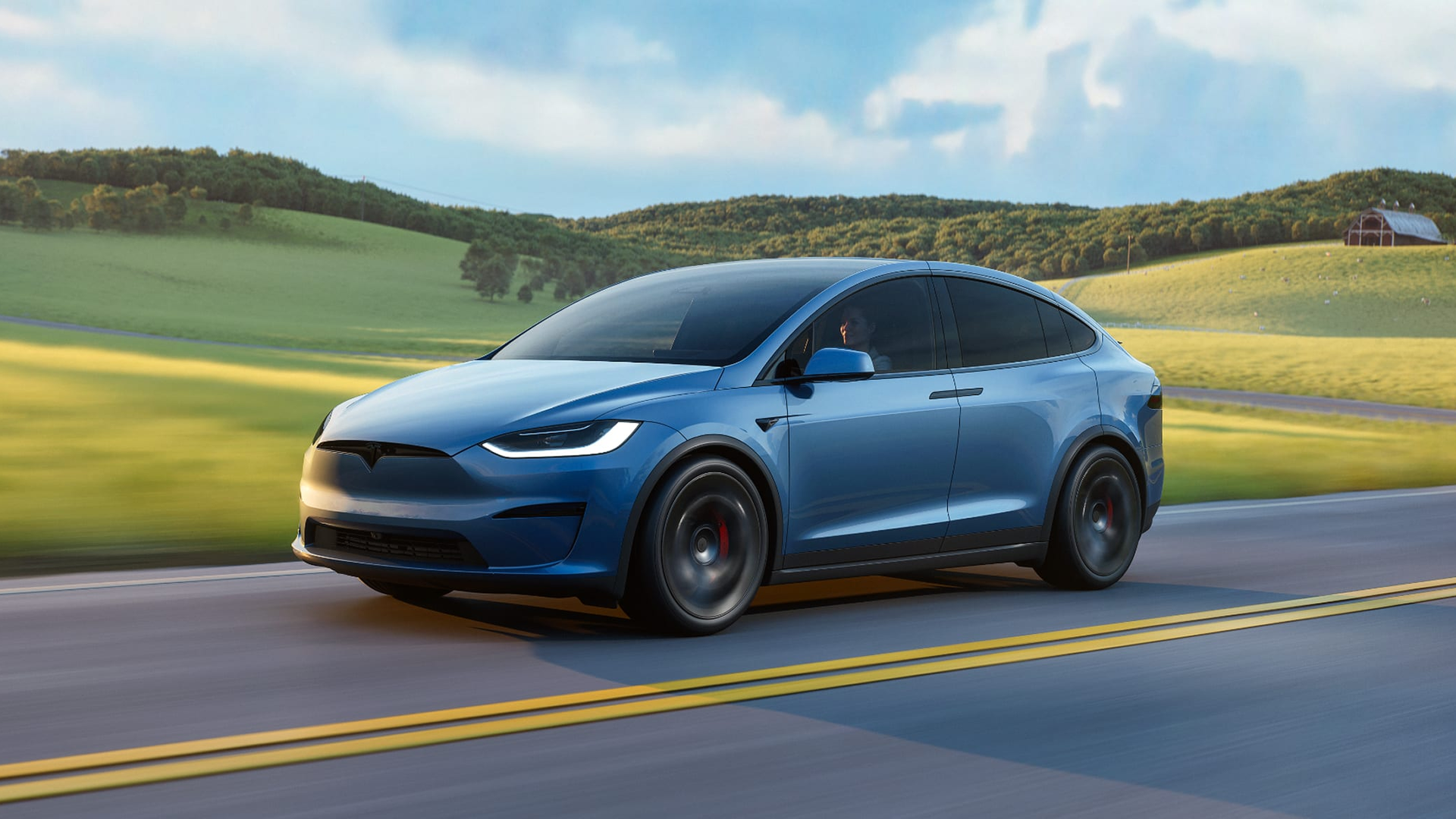
Shattering the Combustion Utility Paradigm
The Tesla Model X completely dismantled the established definitions of what a full-size sport utility vehicle could achieve. Legacy automakers spent decades attempting to mask the inherent dynamic flaws of heavy, high-riding family haulers. Tesla engineers ignored these historical compromises, executing a clean-sheet design based entirely on a native BEV skateboard architecture. By positioning a massive, multi-hundred-pound lithium-ion battery pack completely flat beneath the floor pan, the Model X achieves a center of gravity comparable to a mid-engine exotic sports car. This extreme low-slung mass drastically neutralizes the violent body roll typically associated with aggressive SUV cornering.
This skateboard chassis utilizes a hybrid construction of high-strength steel and aerospace-grade aluminum. The battery enclosure functions as a stressed structural member, massively increasing the torsional rigidity of the unibody shell. When the heavy crossover dives into a sharp hairpin turn, the rigid floor prevents the chassis from twisting, keeping the suspension geometry perfectly aligned and the massive tires firmly planted on the asphalt. The absence of a large internal combustion engine block transforms the entire front end into an unobstructed, highly efficient crumple zone, allowing the frame rails to absorb and dissipate catastrophic kinetic energy long before it breaches the passenger compartment.
The National Highway Traffic Safety Administration crash testing data revealed that the Tesla Model X possesses the lowest rollover probability of any SUV ever produced in automotive history, a direct result of its floor-mounted battery architecture.
The Kinematics of Falcon Wing Doors
No element of the Model X draws more intense scrutiny than the articulated rear passenger access system. Tesla engineers rejected traditional sliding mechanisms or standard hinged doors, developing the complex Falcon Wing doors. These structures utilize a sophisticated double-hinged design, allowing them to open up and out simultaneously. This specific kinematic articulation permits the doors to open fully in incredibly tight parking spaces, requiring a mere 11 inches of lateral clearance.
Executing this mechanical ballet requires immense sensor integration. The aluminum skin of the doors hides an array of ultrasonic sensors that actively scan the surrounding environment. These sensors fire directly through the metal, mapping adjacent vehicles, low garage ceilings, and physical obstacles. The onboard ECU processes this spatial data in milliseconds, calculating the precise optimal arc for the dual hinges to trace. If a concrete pillar sits too close, the roof hinge articulates sharply, pulling the door tight against the chassis while it ascends to prevent collision.
Removing a massive section of the roof structure to accommodate the Falcon Wing hinges severely compromised the initial structural integrity of the vehicle. To compensate, metallurgists developed a specialized extruded aluminum central spine running down the center of the roofline. This high-strength beam anchors the hinges and restores the torsional rigidity required to meet strict global roof-crush safety mandates.
Propulsion Evolution: From Dual Motor to Plaid Dominance
Powertrain configurations evolved dramatically since the 2015 launch. The foundation of the Model X driving dynamic relies on Dual Motor All-Wheel Drive. By mounting an independent electric motor on both the front and rear axles, the vehicle completely eliminates the mechanical lag of a traditional transfer case and heavy steel driveshaft. The computers digitally vector torque between the front and rear wheels independently. If the front right tire encounters a patch of slick ice, the system cuts amperage to that specific motor and routes maximum power to the rear axle, finding physical grip infinitely faster than any mechanical differential.
The release of the Model X Plaid shattered every preconceived limitation of street-legal SUV acceleration. Engineers discarded the standard dual-motor setup in favor of a complex tri-motor configuration-one motor driving the front axle and two completely independent motors driving the rear wheels. Producing a staggering 1,020 horsepower, this powertrain demanded a complete reinvention of electric motor technology. Traditional EV rotors rip themselves apart due to extreme centrifugal forces at high rotational speeds. Tesla solved this catastrophic failure point by wrapping the Plaid's copper rotors in a specialized carbon fiber overwrap.
The carbon sleeve is wound at extremely high tension, forcing the rotor to retain its physical shape even while spinning beyond 20,000 RPM. The distinct coefficients of thermal expansion between copper and carbon required brilliant machining tolerances to ensure the microscopic air gap between the stator and rotor remains perfectly consistent. These sleeved motors maintain peak horsepower all the way to the vehicle's top speed, eliminating the characteristic power drop-off experienced by standard electric vehicles above highway cruising velocities. The independent rear motors enable true active torque vectoring, physically rotating the massive SUV around an apex exactly like a lightweight track car.
Model X Plaid Core Specifications
- Powertrain Architecture
- Tri-Motor All-Wheel Drive with Carbon-Sleeved Rotors
- Peak Horsepower
- 1,020 hp
- Peak Torque
- 1,050 lb-ft
- Acceleration (0-60 mph)
- 2.5 seconds
- Quarter Mile Time
- 9.9 seconds
- Towing Capacity
- 5,000 lbs
Battery Chemistry and Thermal Choreography
Dragging a 5,200-pound luxury crossover to 60 mph in 2.5 seconds demands a massive instantaneous current draw, generating immense heat within the battery cells. The Model X utilizes a highly sophisticated liquid thermal management loop. Proprietary extruded aluminum ribbons snake directly between the thousands of individual cylindrical lithium-ion cells. Glycol coolant flows continuously through these ribbons, actively pulling heat away from the core during aggressive drag strip launches. This active cooling infrastructure prevents catastrophic thermal runaway and drastically minimizes long-term battery degradation during high-amperage Supercharging sessions.
To maximize cold-weather touring range, modern Model X variants integrate the patented Octovalve manifold. This complex thermal routing system acts as the central nervous system for vehicle heating. It scavenges waste heat generated by the spinning electric stators and redirects it into the passenger cabin via a highly efficient heat pump. This system drains significantly less high-voltage energy than primitive resistive heating coils, preserving critical battery range in freezing northern climates. The vehicle outputs absolutely zero tailpipe emissions, aggressively offsetting its manufacturing CO2 footprint while slicing silently through the environment.
Aerodynamic Sculpting and Active Air Suspension
Atmospheric resistance brutally punishes electric driving range at interstate speeds. The massive exterior of the Model X was sculpted meticulously within the wind tunnel. The complete lack of an internal combustion radiator allowed designers to seal the front fascia perfectly, routing ambient air smoothly over the hood line. A flat undercarriage prevents suspension components from churning turbulent air beneath the floor pan. An active rear spoiler automatically adjusts its pitch based on vehicle speed, reducing lift and minimizing the low-pressure wake behind the tailgate. These relentless aerodynamic optimizations yield a remarkably low 0.24 Cd.
The vehicle floats on an advanced adaptive air suspension system. The onboard computers constantly analyze road surface inputs, steering angle, and vehicle speed, adjusting the shock absorber damping rates in real-time to swallow harsh potholes. The system features predictive GPS-linked ride height memory. If you regularly encounter a steep driveway that risks scraping the underbelly, the driver can manually raise the suspension. The vehicle logs those precise GPS coordinates and automatically elevates the chassis every time it approaches that exact location in the future.
The Panoramic Command Center and Bioweapon Defense
Entering the cabin reveals an interior that aggressively rejects a century of automotive analog tradition. The driver commands the vehicle beneath the largest panoramic glass windshield in production. This massive sheet of acoustic-laminated glass sweeps continuously from the hood to the B-pillar, providing an unobstructed helicopter-like view of the sky. A complex solar gradient tint protects occupants from harsh ultraviolet exposure and severe heat transfer.
The dashboard centers around a cinematic 17-inch high-definition touchscreen, powered by an internal processing unit capable of 10 teraflops of raw computing power-rivaling modern dedicated gaming consoles. Physical buttons are virtually eradicated. The controversial steering yoke replaces the traditional circular wheel, offering a completely unobstructed view of the frameless digital instrument cluster. The climate control system utilizes hidden, invisible vents spanning the width of the dashboard, directing air precisely via touchscreen manipulation.
Tesla integrated a massive medical-grade HEPA filtration system into the front fascia. Activating Bioweapon Defense Mode positively pressurizes the cabin, physically scrubbing 99.97 percent of exhaust particulates, toxic smog, airborne bacteria, and pollen from the incoming ambient air before it reaches the occupants' lungs.
Interior Dimensions and Capacity
- Seating Configurations
- Five, Six (Captain's Chairs), or Seven Passengers
- Total Cargo Volume
- 88 ft3 (with rear seats folded)
- Front Trunk (Frunk) Volume
- 6.5 ft3
Silicon Brains: Tesla Vision and FSD Hardware
The Model X serves as a rolling data-collection platform for autonomous driving development. Standard Autopilot provides robust traffic-aware cruise control and precise lane centering. The system utilizes a sophisticated array of high-resolution exterior cameras. Tesla famously abandoned radar and ultrasonic sensors entirely in favor of Tesla Vision, an architecture relying exclusively on optical photon data and advanced neural net processing to interpret the complex surrounding environment.
Vehicles equipped with the optional Full Self-Driving (FSD) capability utilize a custom-designed silicon chip executing trillions of operations per second. This hardware processes visual data in real-time, allowing the vehicle to navigate complex urban intersections, recognize traffic signals, and execute highway interchanges safely. The software architecture constantly evolves. Engineers push firmware updates OTA via standard Wi-Fi connections, continually refining braking algorithms, unlocking additional motor horsepower, and expanding the autonomous feature set while the vehicle sits parked in a garage.
Towing Physics and Family Logistics
Utility remains the core directive of any SUV. The Model X boasts a formidable 5,000-pound maximum towing capacity. Pulling heavy loads drastically alters vehicle physics. When the driver connects a trailer harness, the software automatically engages Tow Mode. This specialized calibration extends the air suspension to a stable ride height, aggressively limits the regenerative braking curve to prevent aggressive trailer load shifts, and activates advanced trailer sway mitigation algorithms that selectively apply the physical brakes to individual wheels to counteract dangerous oscillation.
The Model X destroyed the myth that a zero-emission family vehicle must be slow, visually uninspiring, or confined to low-speed city limits. By combining aerospace-grade door kinematics, the immediate violence of tri-motor acceleration, and the pragmatic utility of a seven-seat interior, it established an uncompromising technological benchmark that forced the entire global automotive industry to rapidly rethink the future of the sport utility vehicle.