
Igniting the High-Performance Electric Paradigm
The Tesla Roadster fundamentally rewrote the physics of automotive performance, single-handedly dragging the global transportation sector into the electric era. Prior to its 2008 debut, battery-powered vehicles were universally dismissed as glorified golf carts, plagued by severe range limitations and abysmal acceleration. Tesla engineers rejected this compromise, setting out to build a machine that leveraged the instantaneous torque delivery of electric motors to humiliate established European exotic cars. The strategy was brilliant in its simplicity: combine lightweight British sports car dynamics with dense, laptop-grade lithium-ion battery chemistry.
Developing a native electric architecture from a blank sheet requires massive capital and years of crash testing. To bypass this agonizing development cycle, the engineering team partnered with Lotus Cars. Tesla utilized the bonded extruded aluminum chassis of the Lotus Elise as a foundational "glider." However, shoehorning a heavy high-voltage battery pack and a massive electric stator into a chassis designed for a lightweight four-cylinder engine required extreme metallurgical and structural intervention. By the time the vehicle reached production, it shared less than seven percent of its physical components with the Elise. The wheelbase was stretched, the rear subframe was completely redesigned to manage massive torsional loads, and all exterior panels were molded from lightweight, resin-infused carbon fiber to offset the battery mass.
The original Tesla Roadster was the first highway-legal serial production all-electric car to use lithium-ion battery cells, and the first production all-electric car to travel more than 200 miles per charge.
First-Generation Architecture: The 18650 Cell Revolution
The beating heart of the first-generation Roadster was its Energy Storage System (ESS). Rather than waiting for the chemical industry to develop specialized large-format automotive batteries, engineers cleverly repurposed existing technology. The high-voltage pack consisted of 6,831 individual 18650-format lithium-ion cells-the exact same cylindrical batteries utilized in premium laptop computers of the era. Formulated with a cobalt-oxide chemistry, these cells offered unprecedented energy density, but they presented a terrifying thermal management challenge.
Packing nearly seven thousand volatile chemical reactors into a tight enclosure directly behind the driver requires flawless thermoregulation. If a single cell experienced a thermal runaway event, the ambient heat could trigger adjacent cells, resulting in a catastrophic vehicle fire. To mitigate this physical threat, engineers designed a proprietary liquid cooling loop. A specialized 50/50 mixture of water and ethylene glycol circulated constantly through flat aluminum cooling tubes woven directly between the cell sheets. This active thermal management maintained the entire pack within an exact optimal temperature window, ensuring safe, continuous high-amperage discharge during aggressive driving.
The Transmission Crisis and the Powertrain Pivot
The initial powertrain design paired a 3-phase, 4-pole alternating current (AC) induction motor with a two-speed manual gearbox supplied by Xtrac. The engineering theory assumed a multi-speed transmission was necessary to achieve both aggressive off-the-line acceleration and a high top speed. The physical reality proved disastrous. The immense, instantaneous zero-RPM torque generated by the electric motor violently sheared the gear teeth under heavy load. First gear was actively destroying the transmission cases.
Facing a massive production delay, engineers executed a brilliant mechanical pivot. They completely abandoned the two-speed gearbox, partnering with BorgWarner to develop a highly robust, single-speed fixed-gear transaxle. To compensate for the loss of torque multiplication that first gear provided, Tesla massively upgraded the power electronics. The new inverter processed higher amperage, feeding more raw power into the AC induction motor. This hardware revision allowed the single-speed Roadster to retain its brutal 3.7-second sprint to 60 mph while simultaneously increasing powertrain reliability exponentially.
Original Tesla Roadster (Sport Trim) Specifications
- Powertrain Architecture
- Rear-Mounted AC Induction Motor, Single-Speed Transaxle
- Peak Horsepower
- 288 hp @ 4,400 - 6,000 RPM
- Peak Torque
- 295 lb-ft @ 0 - 5,100 RPM
- Battery Capacity
- 53 kWh Lithium-Ion
- EPA Estimated Range
- 244 miles
- Curb Weight
- 2,723 lbs
The Starman Payload: A Cosmic Marketing Triumph
The legacy of the original Roadster transcends the automotive industry. In February 2018, Elon Musk utilized his personal Midnight Cherry first-generation Roadster as the dummy payload for the maiden flight of the SpaceX Falcon Heavy rocket. Secured to the payload adapter and piloted by a spacesuit-clad mannequin dubbed "Starman," the vehicle was blasted out of the Earth's atmosphere. The electric sports car was successfully injected into a heliocentric orbit, traveling millions of miles through the vacuum of space, serving as the most audacious piece of automotive marketing in human history.
The Second Generation Concept: Reclaiming the Hypercar Crown
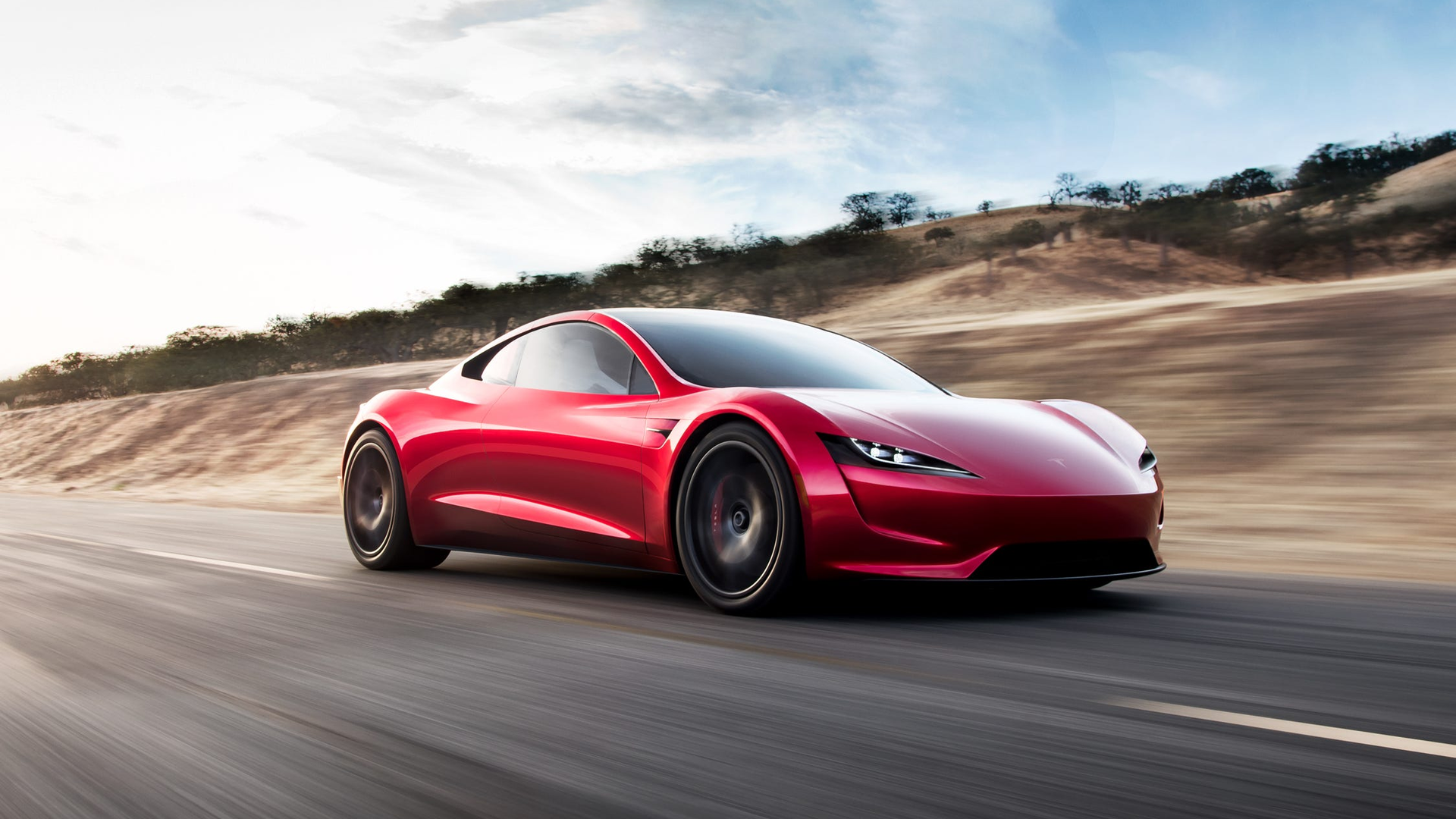
In late 2017, Tesla shocked the global press by rolling a second-generation Roadster prototype out of the back of a semi-truck. While the original vehicle proved electric cars could be fast, the second generation was engineered as a concept to prove internal combustion engines are completely obsolete. Evolving through years of development hell into the 2020s, the design shifted away from a small, agile sports car into the realm of the apex hypercar. The physical footprint expanded drastically, adopting a low-slung, ultra-wide aggressive stance prioritizing aerodynamic downforce and massive mechanical grip.
Propulsion transitions from the single-motor setup to a devastating tri-motor architecture. This "Plaid-derived" powertrain utilizes one electric motor on the front axle and two entirely independent motors on the rear axle. Because there is no physical driveshaft connecting the rear wheels, the onboard computers can digitally vector torque in a matter of microseconds. When diving into a high-speed corner, the system aggressively overdrives the outside rear wheel while applying negative torque to the inside wheel, physically rotating the heavy vehicle around the apex.
The SpaceX Option Package: Cold-Gas Thrusters
The most radical engineering claim surrounding the upcoming new Roadster is the integration of actual aerospace hardware. The optional "SpaceX Package" aims to completely replace the small rear jump seats with highly reinforced Composite Overwrapped Pressure Vessels (COPV). These high-strength carbon-fiber spheres store atmospheric air compressed to an extreme 10,000 psi by an onboard electric pump.
This high-pressure air feeds directly into an array of cold-gas thrusters discretely hidden behind the rear license plate. During a maximum-effort launch, the rear thrusters detonate, expelling the compressed air to generate actual physical thrust, supplementing the traction-limited rubber tires. This theoretical application of Newtonian physics aims to drop the 0-60 mph acceleration time below the 1-second threshold, pushing the absolute physical limits of human g-force tolerance.
Second Generation Target Specifications (Pending Production)
- Powertrain Architecture
- Tri-Motor All-Wheel Drive with Torque Vectoring
- Wheel Torque
- 10,000 Nm (Calculated after gear multiplication)
- Acceleration Target (0-60 mph)
- Sub-1.0 second (With SpaceX Package)
- Top Speed
- 250+ mph
The Tesla Roadster represents the absolute bleeding edge of automotive ambition. The first generation proved that electric propulsion possessed the visceral excitement required to capture the imagination of driving enthusiasts. The highly anticipated second generation serves as a definitive technological manifesto, ensuring that whenever it finally hits the asphalt, the ultimate benchmark for automotive performance will never burn fossil fuels again.