
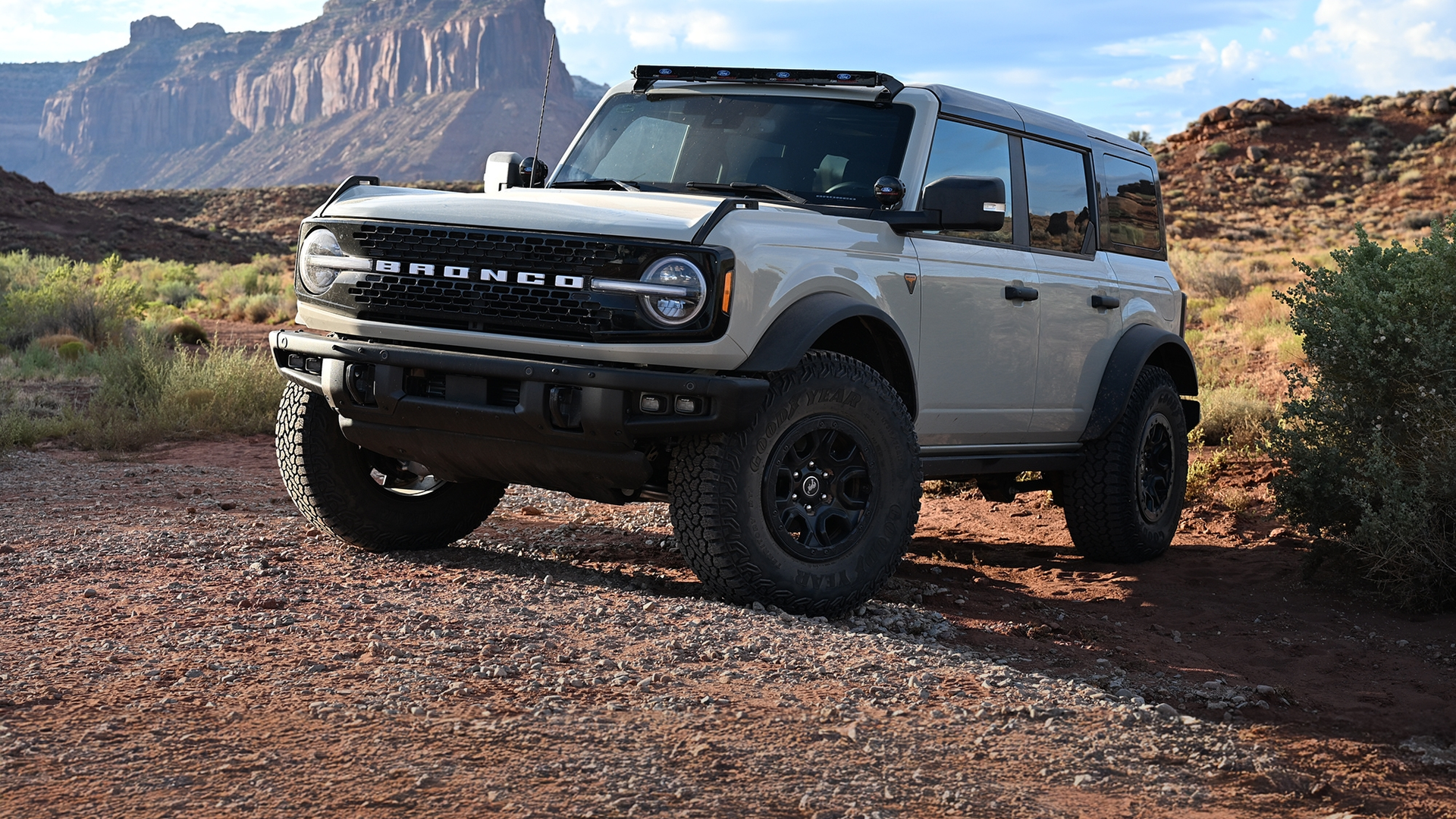
The Return of the King
In the pantheon of American automotive history, few names carry the weight of the Ford Bronco. For decades, it was the definition of the two-door, 4x4 lifestyleâa vehicle that looked just as natural on a muddy trail as it did parked at a beach bonfire. After a 25-year hiatus that left a gaping hole in the off-road market (and allowed the Jeep Wrangler to run unopposed), Ford brought the legend back in 2021. And they didn't just bring it back; they reinvented it.
When you browse the Bronco lineage on Hugegarage, you are looking at two distinct animals sharing one soul: the Vintage Broncos (1966â1996), which are now blue-chip collectibles, and the Modern Broncos (2021âPresent), which are marvels of computer-aided engineering designed to democratize off-road capability. This guide will walk you through every generation, engine choice, and common pitfall to help you find the right horse for your stable.
The G.O.A.T. Philosophy: The original product manager for the 1966 Bronco, Donald Frey, dubbed it the G.O.A.T. Goes Over Any Terrain. Ford revived this acronym for the modern era to name their drive mode selector (G.O.A.T. Modes), bridging 50 years of history with a single button.
Generation 1: The Early Bronco (1966â1977)
This is the holy grail. Small, boxy, and utterly charming, the first-generation Bronco was built on a unique chassis not shared with any other Ford. It was designed specifically to fight the Jeep CJ-5 and the International Harvester Scout.
Key Features Collectibility
- Design: The iconic flat glass, short wheelbase (92 inches), and round headlights define the classic 4x4 aesthetic.
- Engines: Started with a humble 170ci inline-6, but the legends carry the 289 V8 or the 302 V8.
- The Uncut Factor: In the 80s and 90s, owners hacked the rear fenders to fit bigger tires. Today, an original Uncut Bronco is worth significantly more than a cut one.
- The Market: These are investment-grade assets. A pristine 1970s Bronco can easily fetch over $100,000 at auction. Rust is the enemy; check the door posts and rocker panels religiously.
Generation 2-5: The Big Bronco Era (1978â1996)
In 1978, the Bronco grew upâliterally. To compete with the Chevy K5 Blazer, Ford moved the Bronco onto the shortened F-150 truck platform. These are full-size trucks with a camper shell.
- Gen 2 (1978-1979)
- The shortest run but arguably the most desirable of the big trucks. They featured the solid front axle (Dana 44) and massive V8s (351M/400). They are rugged, simple, and rapidly appreciating.
- Gen 3 (1980-1986)
- The introduction of the famous Twin-Traction Beam (TTB) independent front suspension. This controversial design offered better ride quality than a solid axle but can be difficult to align if lifted incorrectly.
- Gen 4 (1987-1991)
- The Bricknose era. Introduced Electronic Fuel Injection (EFI) and rear anti-lock brakes.
- Gen 5 (1992-1996)
- The final run of the old guard, famously associated with the O.J. Simpson low-speed chase. These are the most modern of the classics, featuring airbags and the legendary Eddie Bauer trims. They are currently the value buy in the vintage market.
The Hiatus (1997â2020)
Why did the Bronco die? Consumer tastes shifted to four-door SUVs like the Ford Explorer. The two-door, gas-guzzling brute didn't fit the 90s suburban lifestyle. For 25 years, enthusiasts begged Ford to bring it back.
Generation 6: The Modern Marvel (2021âPresent)
Ford targeted the Jeep Wrangler directly with the 6th Generation Bronco. Unlike the Bronco Sport (which is a unibody crossover based on the Escape), the big Bronco is a body-on-frame truck built alongside the Ranger.
Engineering: IFS vs. Solid Axle
The biggest difference between the modern Bronco and the Wrangler is the front suspension.
Jeep Wrangler: Solid Front Axle. Better for extreme rock crawling articulation.
Ford Bronco: Independent Front Suspension (IFS). Significantly better for high-speed desert running and daily highway driving.
The Verdict: Unless you are doing the Rubicon Trail every weekend, the Bronco's IFS is superior for 99% of drivers.
Understanding the Trims and Packages
Ford offers a dizzying array of options. Here is the decoder ring:
- Base: A blank canvas for modifiers. Steel wheels, cloth seats.
- Big Bend: The mainstream choice. Adds creature comforts and alloy wheels.
- Black Diamond: The tough build. Steel bumpers, rock rails, and vinyl wash-out interior. Ideal for muddy trails.
- Outer Banks: The Mall Crawler. Painted fender flares, leather seats, tech heavy. Designed for the street.
- Badlands: The serious off-roader. Front Sway-Bar Disconnect (hydraulic), front and rear lockers, steel bumpers. This is the rubric for capability.
- Wildtrak: The high-speed desert runner. Comes standard with the Sasquatch package and the 2.7L V6.
The Sasquatch Package Explained
This is the single most important option on the build sheet. It turns any trim level into a monster.
What you get:
1. 35-inch Mud-Terrain Tires (Goodyear Territory MT).
2. Front and Rear Electronic Locking Differentials.
3. 4.70 Final Drive Ratio (for crawling).
4. HOSS 2.0 Suspension with Bilstein Position-Sensitive Dampers.
5. High-Clearance Fender Flares.
Hugegarage Advice: If you plan to off-road, get the Sasquatch. It is cheaper to buy it from the factory than to build it yourself later.
Powertrains: EcoBoost vs. The World
Purists cried when Ford announced there would be no V8 (except for the Raptor R, but we'll get to that). However, the EcoBoost engines are potent.
- 2.3L EcoBoost Inline-4
- 275 HP / 315 lb-ft Torque. Do not underestimate this engine. It is lighter, helping handling, and is the only engine available with the 7-Speed Manual Transmission.
- 2.7L EcoBoost V6
- 315 HP / 410 lb-ft Torque. The powerhouse. It uses a graphite-iron block (like a diesel) for durability. It is paired exclusively with the 10-Speed Automatic.
- 3.0L EcoBoost V6 (Raptor)
- 418 HP. Reserved for the Bronco Raptor.
The 7-Speed Manual: The Crawler Gear
The manual transmission is a Getrag unit labeled as 6+1.
The C gear is a specialized Crawler Gear with a massive ratio. When combined with the low-range transfer case and the rear axle ratio, it provides a Crawl Ratio of 94.75:1. This allows the Bronco to creep up a wall at 1 MPH without the driver touching the gas or the clutch. It is an engineering masterpiece.
The Bronco Raptor: The Apex Predator
Released in 2022, the Braptor is effectively a street-legal trophy truck.
Width: It is 9.8 inches wider than a standard Bronco.
Suspension: FOX Live Valve 3.1 shocks with internal bypass.
Chassis: Reinforced frame towers.
It is massive, loud, and incredibly fast over rough terrain. However, it is too wide for many narrow forest trails, making it better suited for the open desert (Baja style) than tight woods.
Buyer's Guide: Issues to Watch
No vehicle is perfect. Here is what to check before you buy.
1. The Hardtop Headaches
Early 2021 models had issues with the Molded-in-Color (MIC) hardtops. They developed honeycomb patterns and discoloration. Ford replaced many under warranty, but if you are buying a used 2021, ensure the roof has been updated to the 2.0 version.
2. Wind Noise
The Bronco has a removable roof and frameless doors. It is loud on the highway. Not as loud as a soft-top Wrangler, but significantly louder than an Explorer. Do not expect a luxury car experience at 75 MPH.
3. The 2.7L Valve Issue (2021 Early Builds)
A very small batch of early 2.7L engines had defective intake valves that could drop and destroy the engine. This is a known issue (NHTSA investigation), and most affected units have likely failed and been replaced by now. Check the engine build date if shopping for an early 2021 model.
The Future: Electrification?
While Ford has the F-150 Lightning and Mustang Mach-E, a Bronco EV has not been confirmed. However, a Bronco Hybrid is widely expected to compete with the Jeep Wrangler 4xe. For now, the Bronco remains a celebration of internal combustion capability.
Conclusion: The Spirit of Adventure
The Ford Bronco is more than a car; it is a lifestyle accessory that actually works. It invites you to take the long way home. It encourages you to take the roof off on a Tuesday just because the sun is out. Whether you are restoring a 1970 classic to relive your youth or buying a Sasquatch to forge new memories, the Bronco is a machine built for joy. It is rough, it is tough, and it is undeniably American. Explore the listings below to find your wild horse.