
The Vehicle That Changed Everything
Before 1990, if you had a family of five, you drove a minivan or a station wagon. If you drove an SUV, it was likely a rough-riding Jeep or a massive Chevy Suburban. The Ford Explorer changed the equation forever. By taking the rugged underpinnings of the Ford Ranger pickup and adding four doors, a comfortable interior, and effortless style, Ford created the Sport Utility Vehicle boom that continues to this day.
When you browse the Ford Explorer listings on Hugegarage, you are looking at the best-selling SUV nameplate in US history. Its lineage tells the story of the automotive industry itself: starting as a crude body-on-frame truck, evolving into a unibody crossover for efficiency, and recently returning to a Rear-Wheel Drive architecture to satisfy driving enthusiasts. Whether you remember it from Jurassic Park or recognize it as the police car in your rearview mirror, the Explorer is an American institution.
The Police Interceptor Utility: After the Ford Crown Victoria was discontinued in 2011, the Explorer (specifically the Police Interceptor Utility) became the standard patrol vehicle of the United States. It offers AWD traction, massive cargo space for gear, and pursuit-rated performance. If you see a black Ford SUV with steel wheels, check your speedometer.
Generation 1 & 2: The Truck Era (1991â2001)
The early Explorers were honest trucks. Built on the UN46 platform, they shared much of their DNA with the Ford Ranger.
The Mechanicals
- Suspension: The front used the famous (or infamous) Twin-Traction Beam (TTB) independent suspension, while the rear was a solid axle on leaf springs. This gave it decent off-road chops but a bouncy ride.
- Engines: The 4.0L Cologne V6 was the standard. In 1996, the 5.0L Windsor V8 became available in the AWD models, creating a legendarily reliable (though thirsty) package.
The Firestone Legacy
It is impossible to discuss the Gen 2 Explorer without mentioning the tire recall. A combination of low recommended tire pressure (26 PSI) and tire tread separation led to rollover accidents. This crisis had a massive positive impact on the industry: it forced the government to mandate Electronic Stability Control (ESC) and Tire Pressure Monitoring Systems (TPMS) on all future vehicles.
Generation 3 & 4: The Independent Era (2002â2010)
For 2002, the Explorer was redesigned from the ground up (code U152).
The Big Change: It adopted Independent Rear Suspension (IRS). The solid axle was gone, replaced by a half-shaft setup where the differential passed through the frame rails.
Why? This lowered the floor, allowing for a fold-flat third rowâsomething the Chevy TrailBlazer couldn't match. Ride quality improved drastically, but the towing capacity and off-road articulation suffered slightly.
Generation 5: The Unibody Revolution (2011â2019)
This is the most common Explorer on the road today. Ford abandoned the truck frame entirely, moving the Explorer to the D4 Platform shared with the Ford Taurus and Volvo XC90.
The Configuration: Transverse Engine, Front-Wheel Drive (FWD) based, with optional AWD.
The Powertrains
- 3.5L Ti-VCT V6 (Duratec)
- The standard engine. 290 HP. Reliable, but prone to water pump failure (see below).
- 2.0L / 2.3L EcoBoost
- The fuel-saver options. These 4-cylinders struggled to move the heavy SUV until the 2.3L upgrade in 2016.
- 3.5L Twin-Turbo EcoBoost (Sport)
- The game changer. 365 HP. This engine turned the soccer mom SUV into a rocket ship. It was the basis for the Police Interceptor.
Critical Maintenance: The Water Pump Bomb
Hugegarage Warning: On the 3.5L and 3.7L V6 engines in this generation, the water pump is located inside the timing cover and driven by the timing chain.
The Risk: When the water pump bearing wears out, coolant leaks internally into the oil pan. This creates a chocolate milkshake slurry that destroys the engine bearings instantly.
The Fix: Replacing the water pump is a $2,000 labor-intensive job. If buying a Gen 5 with over 100,000 miles, ask for proof of replacement.
Generation 6: Return to Rear-Wheel Drive (2020âPresent)
For 2020, Ford did something enthusiasts loved. They moved the Explorer to the new CD6 Platform.
The Configuration: Longitudinal Engine, Rear-Wheel Drive (RWD) based.
Why it matters: RWD offers better towing balance, better steering feel, and allows for a longer hood/dash-to-axle ratio which looks more premium. It is the same architecture used by the Lincoln Aviator.
The Modern Engine Lineup
- 2.3L EcoBoost (I-4): The standard engine is a powerhouse. 300 HP and 310 lb-ft of torque. It feels stronger than the old V6s.
- 3.0L EcoBoost V6 (ST / Platinum): A monster. 400 HP and 415 lb-ft of torque. It propels the 3-row SUV to 60 MPH in 5.2 seconds.
- 3.3L V6 Hybrid: Designed for police duty but available to civilians. It prioritizes torque and range (500+ miles per tank) rather than Prius-like MPG numbers.
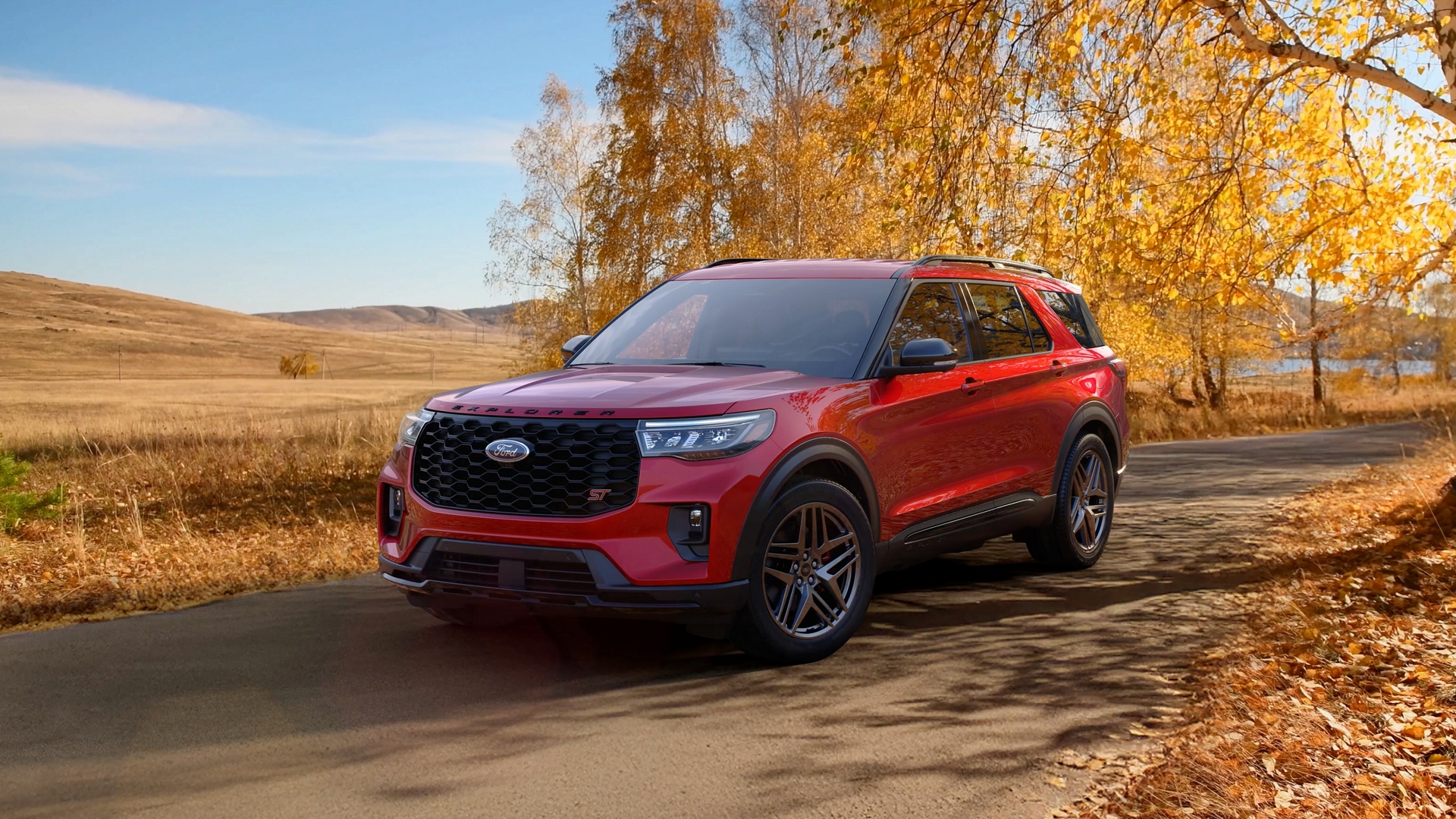
The Explorer ST: A Genuine Performance SUV
The ST (Sport Technologies) trim replaced the Sport. It is not just a badge.
Upgrades: Stiffer springs, larger sway bars, heavy-duty brakes (painted red), and a tuned 10-speed transmission that shifts aggressively in Sport mode. It is widely considered one of the best performance bargains in the market, offering near-German performance for half the price.
Interior & Technology
The modern Explorer (Gen 6) features a controversial 10.1-inch Portrait Touchscreen (optional) that stands upright on the dash like a tablet. While some find it looks tacked on, it allows for a massive vertical map view.
Captain's Chairs: Standard on many upper trims. They feature a pass-through for kids to access the third row easily.
Cargo: 18.2 cubic feet behind the third row. It is decent, but if you need to carry luggage for 6 people, you really need an Expedition.
Common Issues & What to Watch
1. PTU Failures (Gen 5)
The Power Transfer Unit (which sends power to the rear wheels in AWD models) holds very little fluid and sits near the hot catalytic converter. The fluid cooks into sludge. Change the PTU fluid every 30,000 miles to prevent failure.
2. Transmission Coolers (Gen 6)
Early 2020 models had issues with transmission fluid coolers leaking. Ford issued a recall/TSB. Ensure this has been addressed.
3. Build Quality (2020 Launch)
The launch of the 2020 Explorer at the Chicago Assembly Plant was messy. Early builds had panel gap issues, software glitches, and wiring harness problems. A 2021 or newer model is generally much safer as the quality control issues were ironed out.
Towing Capacity
One of the main reasons to choose an Explorer over a competitor like the Highlander is towing.
Gen 6 (2020+) Ratings:
- 2.3L EcoBoost: 5,300 lbs
- 3.0L EcoBoost: 5,600 lbs
- Hybrid: 5,000 lbs
This allows the Explorer to tow a substantial boat or travel trailer that would exceed the limits of most FWD-based crossovers.
Conclusion: The Standard Bearer
The Ford Explorer has survived for over 30 years because it adapts. It was a truck when people wanted trucks; it became a crossover when people wanted efficiency; and it became a RWD performance machine when people wanted excitement. It is the Swiss Army Knife of the American roadâcapable of police chases, school runs, and boat launches with equal competence. While reliability on high-mileage older models requires vigilance (watch that water pump), a well-maintained Explorer remains the gold standard for the versatile family SUV. Explore the generations below.