
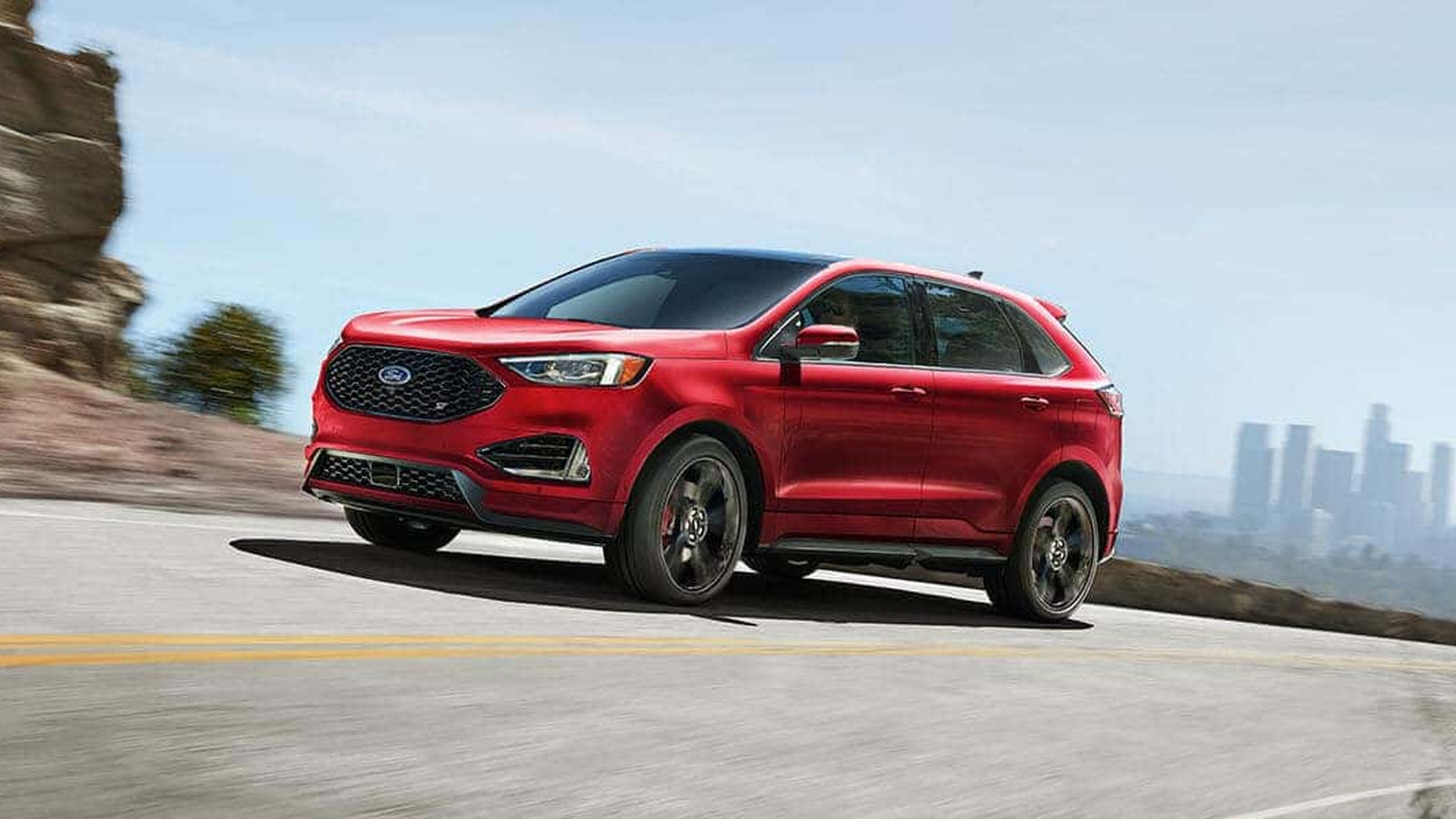
The Goldilocks of the SUV World
In a market obsessed with cramming as many seats as possible into a vehicle, the Ford Edge dared to be different. It asked a simple question: What if we built a large SUV, but strictly for five people? The result was a revelation. By rejecting the cramped third row found in competitors, the Ford Edge offered a second row with limousine-like legroom and a cargo area capable of swallowing a month's worth of groceries.
When you browse the Ford Edge listings on Hugegarage, you are looking at the benchmark for the Mid-Size 2-Row Crossover segment. It bridged the gap between the utilitarian Ford Escape and the family-hauling Ford Explorer. Over two generations, it evolved from a stylish boulevard cruiser into a technologically advanced, performance-oriented machine that challenged luxury brands for cabin quietness and ride quality.
The Silent Standard: Ford engineers benchmarked the 2nd Generation Edge against the Audi Q5 for interior noise levels. By using acoustic-laminated glass on the windshield and front side windows, plus active noise cancellation in higher trims, the Edge became one of the quietest non-luxury vehicles on the highway.
Generation 1: The Bold Beginning (2007â2014)
Launched in late 2006, the first-generation Edge was built on the CD3 Platform, shared with the Mazda6 and Ford Fusion. It was instantly recognizable by its massive three-bar chrome grille and bubble shape.
The Powertrains: Duratec Dominance
Unlike modern turbos, this era was ruled by displacement.
- 3.5L Duratec V6
- The bread and butter. Producing 265-285 HP, this naturally aspirated V6 was smooth and reliable, though thirsty.
- 3.7L Duratec V6 (Sport Trim)
- Introduced in 2011, this engine came from the Mustang. With 305 HP and massive 22-inch wheels, the Edge Sport was the first hint that a crossover could be fun to drive.
- 2.0L EcoBoost (The Experiment)
- Added late in the cycle (2012). It prioritized fuel economy but struggled to move the heavy Edge with authority compared to the V6s.
The MyFord Touch Era
The 2011 facelift introduced the controversial MyFord Touch infotainment system. While visually futuristic, it was plagued by lag and crashes. Buyer's Tip: If buying a 2011-2014 Edge, ensure the SYNC software has been updated to the final version (3.10) by a dealer to resolve most stability issues.
Generation 2: The Global Powerhouse (2015â2024)
For 2015, the Edge moved to the global CD4 Platform (shared with the Lincoln MKZ and Ford Fusion). This chassis was significantly stiffer, featuring a new integral-link rear suspension that transformed the ride quality from truck-like to European Sedan-like.
The EcoBoost Revolution
Ford went all-in on turbocharging for this generation.
- 2.0L Twin-Scroll EcoBoost: Became the standard engine. The Twin-Scroll turbo design reduced lag significantly compared to the Gen 1 version. It produces 250 HP and 280 lb-ft of torque, making it punchy enough for daily driving.
- 2.7L Twin-Turbo V6 (Sport / ST): The masterpiece. Originally found in the F-150, this engine turns the Edge into a rocket. With 335 HP and 380 lb-ft of torque, it embarrasses many dedicated sports cars at stoplights.
The 2019 Refresh: Enter the ST
In 2019, Ford replaced the Sport trim with the ST (Sport Technologies) badgeâthe first SUV to earn it.
The Upgrades:
1. Performance Tuned Suspension: Stiffer springs and dampers for flatter cornering.
2. Brake Package: Optional larger rotors with performance pads (often painted red).
3. Transmission: A new 8-speed automatic replaced the old 6-speed, though shift logic remained comfort-biased unless in Sport mode.
4. Aesthetics: Blacked-out honeycomb grille, aggressive bolstered seats, and distinct 20 or 21-inch wheels.
Interior & Technology: The Portrait Screen
The defining feature of the late-model Edge (2021+) is the 12-inch Vertical Touchscreen running SYNC 4A.
Unlike the horizontal screens in the Explorer, the Edge's screen mimics a tablet. It supports Wireless Apple CarPlay and Android Auto, allowing you to view navigation maps on a massive scale. The system also learns your habits, suggesting destinations or phone contacts based on the time of day.
Cargo Mastery
Because there is no third row to fold, the cargo floor is flat and low.
Volume: 39.2 cubic feet behind the second row / 73.4 cubic feet with seats folded.
To put that in perspective, the Edge holds more luggage than a short-wheelbase Lincoln Navigator behind the seats. The EasyFold buttons in the trunk allow you to drop the rear seats electronically, a feature usually reserved for luxury cars.
Mechanical Reliability: What Breaks?
The Edge is generally robust, but there are three specific mechanical failures every buyer must know.
1. The PTU (Power Transfer Unit) Failure
Affected Models: All AWD models (Gen 1 & Gen 2).
The Issue: The PTU transfers power to the rear wheels. It holds a tiny amount of fluid (less than 1 quart) and sits right next to the scorching hot catalytic converter. The heat cooks the fluid into sludge.
The Symptom: A smell of propane/gear oil or black sludge leaking from the vent. If ignored, the PTU explodes.
Hugegarage Fix: Change the PTU fluid every 30,000 miles, even though Ford claims it is Lifetime Fluid. It is the only way to save the unit.
2. Internal Water Pump (Gen 1 V6 Only)
Affected Models: 3.5L and 3.7L Duratec V6 engines (2007â2014).
The Issue: The water pump is chain-driven and located inside the engine timing cover. When it fails (weeps coolant), it dumps coolant directly into the oil pan.
The Result: The oil turns into a chocolate milkshake, destroying engine bearings instantly.
Advice: If you own a high-mileage Gen 1 V6, replacing the water pump is a $2,000 preventative maintenance job that saves a $6,000 engine replacement.
3. Coolant Intrusion (Gen 2 2.0L)
Affected Models: Early 2.0L EcoBoost engines (2015â2018).
The Issue: A design flaw in the open-deck engine block allowed the head gasket to fail between the cylinders, leaking coolant into the combustion chamber.
The Fix: Ford redesigned the block in late 2019. If buying a used 2015-2018 model, check if the engine has been replaced under warranty.
Trim Level Guide: Finding the Sweet Spot
Ford's trim hierarchy is consistent, but the value changes.
- SE: The fleet special. Cloth seats, small wheels. Avoid unless on a strict budget.
- SEL: The volume seller. Adds heated seats, dual-zone climate, and optional leather (ActiveX). The best value for most families.
- Titanium: The luxury cruiser. Adds the Bang & Olufsen sound system, hands-free liftgate, and ambient lighting. Often creates a better luxury experience than a base Lincoln.
- ST-Line: The Sheep in Wolf's Clothing. It looks exactly like the ST (black trim, red stitching) but keeps the standard 2.0L engine and softer suspension. Ideal for those who want the look without the fuel bill.
- ST: The real performer. 2.7L V6, sport suspension.
Safety: Co-Pilot360
Starting in 2019, Ford made Co-Pilot360 standard on all Edge models. This suite includes:
1. Automatic Emergency Braking with Pedestrian Detection.
2. Blind Spot Information System (BLIS) with Cross-Traffic Alert.
3. Lane Keeping System.
4. Auto High-Beam Headlamps.
This makes even a base model Edge extremely safe for teen drivers.
The Future: The End of an Era
Ford has announced that production of the Edge at the Oakville Assembly Complex will end in 2024 to make way for Electric Vehicle production. This marks the end of the traditional mid-size gas crossover for Ford. As such, late-model Edges (2021-2024) are expected to hold their value well as buyers seek out the last of the reliable, spacious 2-row SUVs before being forced into EVs.
Conclusion: The Smart Choice
The Ford Edge is rarely the flashiest car in the parking lot, but it is often the smartest. It acknowledges the reality that most SUV owners rarely go off-road and rarely carry seven people. By focusing entirely on paving-road comfort for five adults, it delivers a superior experience to the compromised 3-row SUVs in its price bracket. Whether you choose the frugal 2.0L Titanium for highway cruising or the rowdy 2.7L ST for backroad fun, the Edge is a masterclass in packaging and utility. Explore the detailed specs below.